LinkedIn Job Search Export
Export LinkedIn job search results with ease. Use automation to track, save, and organize listings in seconds.
Last updated
LinkedIn continues to dominate as the world’s premier professional networking platform, connecting job seekers and recruiters with opportunities and talent across industries. With millions of job postings updated daily, LinkedIn serves as a vital tool for individuals and organizations alike. However
LinkedIn continues to dominate as the world’s premier professional networking platform, connecting job seekers and recruiters with opportunities and talent across industries. With millions of job postings updated daily, LinkedIn serves as a vital tool for individuals and organizations alike. However, manually tracking and analyzing job postings can be an overwhelming and time-consuming task, often leading to missed opportunities.
Exporting LinkedIn job search data offers a solution by organizing postings into actionable formats for easy review and analysis. Whether you’re a job seeker looking to stay organized, a recruiter refining hiring strategies, or a business owner exploring potential collaborations, exporting job search data ensures that you work smarter, not harder. TexAu’s LinkedIn Job Search Export automates this process, offering users the ability to extract accurate and timely job data effortlessly. By leveraging this tool, you can transform the way you manage job searches, track opportunities, and make strategic decisions.
Key Features of TexAu’s LinkedIn Job Search Export
1. Comprehensive Job Data Extraction
TexAu allows users to export key details from LinkedIn job postings, including:
- Job title
- Company name
- Location
- Job description
- Posting date
- Employment type
- LinkedIn job URL
This detailed data enables users to analyze, organize, and act on job opportunities with precision.
Example Scenario: A project manager seeking roles in technology companies can use TexAu to scrape job postings for relevant positions. The exported data includes details such as job descriptions and required qualifications, helping the job seeker identify the most suitable roles and tailor their applications accordingly.
2. Customizable Filters
TexAu offers advanced filtering options that allow users to narrow down their exports by criteria such as keywords, location, industry, experience level, and company size. This ensures that only the most relevant job postings are extracted.
Example Scenario: A healthcare professional searching for remote mid-level roles can set filters to focus exclusively on job postings in the healthcare sector that match their experience level. With TexAu, they avoid sifting through irrelevant postings, saving time and improving efficiency. For tracking job opportunities within professional networks, LinkedIn Mutual Connections Export helps users analyze shared connections who may influence hiring decisions.
3. Bulk Job Export
Manually saving and exporting job postings one at a time is inefficient and prone to errors. TexAu’s bulk export feature simplifies this process by enabling users to extract multiple job postings simultaneously.
Example Scenario: A data scientist exploring opportunities in the AI field can export over 100 relevant job postings in one go. This bulk extraction ensures they have a comprehensive list of opportunities at their fingertips, eliminating the need for manual searches.
4. Export Formats
Users can download the scraped data in user-friendly formats like CSV or Excel, making it easy to integrate with job tracking tools, CRMs, or analytics platforms. For businesses tracking hiring trends of competitors, LinkedIn Company Search Export provides valuable insights into corporate hiring activities.
Example Scenario: A recruiter analyzing job market trends exports postings into a spreadsheet to track hiring practices across competitors. They use Excel to categorize roles, monitor job posting trends, and identify in-demand skills.
5. Real-Time Updates
TexAu ensures users stay ahead by providing real-time updates on newly posted jobs. By automating the export process, the tool captures the latest postings, enabling users to act on opportunities before others.
Example Scenario: A software engineer targeting positions in cloud computing configures TexAu to run daily exports for new job postings containing keywords like “AWS” or “DevOps.” This ensures they never miss an opportunity to apply for roles as soon as they’re posted.
Challenges Addressed by TexAu’s LinkedIn Job Search Export
1. Manual Job Tracking
Manually saving and organizing individual job postings on LinkedIn is not only time-consuming but also prone to errors. Professionals juggling multiple roles and deadlines often lose track of key postings, leading to missed opportunities. TexAu automates this entire process, enabling users to export hundreds of job postings into a structured format with a single click. For monitoring professional career updates and hiring trends, LinkedIn Post Search Export allows users to extract relevant job-related discussions.
Detailed Example: Consider a job seeker targeting software engineering roles across different industries. Manually bookmarking or copying job details into a spreadsheet takes several hours a week, not to mention the constant risk of missing relevant jobs. By using TexAu, the user can scrape all job postings that match their criteria, such as “Software Engineer” roles requiring experience in Python and cloud computing. The tool exports this data, including job titles, descriptions, and deadlines, into a well-organized spreadsheet. This automation not only saves hours of effort but also ensures no opportunities are overlooked.
2. Information Overload
LinkedIn’s vast database of job postings can feel overwhelming, particularly for job seekers or recruiters trying to identify relevant opportunities. Sorting through countless irrelevant postings to find roles aligned with specific qualifications or needs often leads to frustration. TexAu solves this problem with customizable filters that extract only the most pertinent data.
Detailed Example: A digital marketing specialist searching for roles in SEO finds themselves overwhelmed by the sheer volume of job postings. Most listings are irrelevant to their expertise, either being for entry-level roles or jobs located outside their preferred regions. By applying TexAu’s advanced filters, they target postings with keywords like “SEO Manager” and “remote.” This tailored scraping ensures they extract only jobs aligned with their qualifications and preferences, dramatically reducing the time spent searching.
3. Missed Opportunities
In today’s competitive job market, acting quickly on new opportunities is essential. Job postings on LinkedIn are often updated or filled rapidly, leaving manual job seekers struggling to keep up. TexAu automates the export process, ensuring users always have access to the latest postings.
Detailed Example: A recruiter specializing in cybersecurity relies on TexAu to monitor LinkedIn for new job postings in this field. By setting up a daily automated export for jobs with keywords like “Cybersecurity Analyst” or “Cloud Security Specialist,” the recruiter ensures they always have the most recent openings to work with. This gives them an edge in reaching out to potential candidates before competitors, helping them secure top talent more efficiently.
Benefits of Using TexAu’s LinkedIn Job Search Export
1. Streamlined Job Search
TexAu eliminates the need for manual browsing and saving of job postings, allowing users to focus their efforts on applying to the most relevant roles. By automating this process, TexAu ensures that job seekers can concentrate on what matters most—preparing for interviews and refining their applications. For identifying which job postings are attracting engagement, LinkedIn Post Likers Export helps analyze interaction levels on job-related LinkedIn posts.
Detailed Example: A marketing professional targeting roles in major cities uses TexAu to scrape postings for “Digital Marketing Specialist” positions. Within minutes, the tool compiles a list of active job postings, complete with descriptions, deadlines, and application links. This allows the user to prioritize high-value opportunities and submit tailored applications, significantly increasing their chances of landing interviews.
2. Improved Job Tracking
Managing multiple job applications can be chaotic without a structured system. TexAu consolidates job data into an organized spreadsheet, enabling users to track applications, deadlines, and follow-ups efficiently. For analyzing job postings related to thought leadership articles, LinkedIn Profile Articles Export helps users explore content published by hiring professionals.
Detailed Example: A graduate student seeking data analytics internships uses TexAu to export LinkedIn job postings that match their preferences. The exported data includes key details such as application deadlines, job descriptions, and hiring company information. By organizing this data in a spreadsheet, the student can keep track of which applications they’ve submitted and schedule follow-ups for roles still under consideration. This systematic approach minimizes stress and ensures no deadlines are missed.
3. Market Insights
TexAu provides a wealth of data that can be analyzed to identify job market trends, such as in-demand skills, roles, and salary benchmarks. This information is invaluable for recruiters and businesses looking to stay ahead of the curve.
Detailed Example: A recruitment agency uses TexAu to scrape job postings across the IT sector. Analyzing the data, they notice a sharp increase in demand for “AI Engineers” with expertise in machine learning frameworks like TensorFlow and PyTorch. Recognizing this trend, the agency adjusts its hiring strategies to prioritize candidates with these skills. This proactive approach helps them cater to market demands and position themselves as a leading agency in tech recruitment.
4. Lead Generation
For businesses, job postings often signal opportunities to connect with companies in need of specific services. TexAu enables organizations to identify such leads by extracting postings that align with their niche.
Detailed Example: A SaaS company specializing in team collaboration tools scrapes LinkedIn job postings for “Project Manager” roles. These postings often indicate companies that prioritize efficient team management. By targeting these businesses, the SaaS company can pitch their solutions, positioning their tool as a way to optimize team workflows. This strategy not only generates new leads but also enhances the relevance of their outreach efforts.
5. Enhanced Decision-Making
With TexAu, users can compare job postings side-by-side, evaluating factors like job descriptions, required qualifications, and salary ranges. This data-driven approach helps users prioritize applications and recruitment efforts effectively.
Detailed Example: A job seeker exports postings for multiple roles, comparing factors like required qualifications, company reputation, and growth opportunities. For instance, they identify a role with a slightly lower salary but significant potential for career advancement. With TexAu’s organized data, they make an informed decision to prioritize this opportunity, increasing their likelihood of long-term job satisfaction.
TexAu’s LinkedIn Job Search Export is a powerful solution for tackling the challenges of job tracking, managing information overload, and avoiding missed opportunities. Whether you’re a job seeker looking to streamline your applications, a recruiter analyzing market trends, or a business owner generating leads, TexAu ensures efficiency and precision at every step.
By automating the process of exporting and organizing job postings, TexAu empowers users to focus on strategic decision-making and execution.
Use Cases of TexAu’s LinkedIn Job Search Export
1. Job Seekers
For job seekers, organizing and tracking job postings is crucial in creating an efficient and targeted application strategy. TexAu’s LinkedIn Job Search Export feature allows job seekers to easily export job postings and organize them into actionable lists. By defining the right filters and using the export feature regularly, job seekers can prioritize their applications, set reminders for deadlines, and keep track of their progress. For expanding job search efforts within professional networks, LinkedIn Mutual Connections Export helps job seekers identify hiring managers or recruiters within their extended network.
Example Scenario: A UI/UX designer is on the hunt for new opportunities in major cities like New York, London, and San Francisco. By using TexAu’s job search export tool, the designer collects job postings for UI/UX roles across these cities. They can now organize the postings based on deadlines, role requirements, and company reputation. This enables them to prioritize which applications to submit first based on relevance, industry demand, and the deadlines listed in the job postings.
This organized approach ensures that no opportunities are missed and that job seekers can tailor their applications more effectively. With automated data export, candidates can spend more time refining their resumes and preparing for interviews rather than manually tracking multiple postings.
2. Recruiters
For recruiters, staying on top of market trends and competitors’ hiring strategies is crucial. TexAu’s LinkedIn Job Search Export allows them to monitor job postings from various companies, helping them analyze competitor activity and adjust their hiring practices. By tracking which roles are being posted, recruiters can assess the skills, experience, and qualifications companies are seeking, which in turn informs their recruitment strategy.
Example Scenario: A recruiter specializing in software development roles is looking to stay ahead of the competition. By using TexAu to export job postings from major tech companies like Google, Microsoft, and Apple, the recruiter is able to monitor the types of positions being filled, as well as the experience levels and skill sets that are in high demand. With this information, the recruiter refines their hiring criteria, focusing on attracting candidates with similar qualifications, experience, and technical skills.
This insight allows the recruiter to tailor job descriptions more accurately and streamline the hiring process, improving their chances of finding the right talent quicker and more efficiently. With TexAu, recruiters can gain a competitive edge by staying informed on what industry leaders are looking for in candidates.
3. Business Owners
Business owners can also benefit from using TexAu to export job data from LinkedIn. By tracking job postings across various industries, business owners can gain insights into hiring trends, market demand, and potential opportunities for collaboration. This data helps them identify companies that are expanding their workforce, making them ideal targets for business partnerships or collaborations.For tracking business growth through hiring trends, LinkedIn Company Search Export provides insights into company workforce expansion strategies.
Example Scenario: A product development firm is aiming to identify potential business opportunities with other companies in the tech sector. By using TexAu to scrape job postings for roles like “Product Manager” or “Head of Product” from companies like Google, Amazon, and Tesla, the firm can track which companies are scaling their operations. This information gives the firm a strategic advantage in identifying potential clients or collaborators who are looking to expand their teams and might require product development services.
By using the data exported from LinkedIn, the product development firm can approach these companies with relevant partnership proposals, helping them grow their client base and expand their business offerings. This proactive approach helps them stay ahead of the competition and identify emerging industry needs.
4. Career Coaches
Career coaches use TexAu to help clients navigate the job search process more effectively by providing structured, targeted data. By exporting relevant job postings from LinkedIn, career coaches can offer personalized guidance to their clients, helping them focus on roles that best match their skill sets and aspirations.
Example Scenario: A career coach is working with a client who is transitioning from a project management role into an executive leadership position. By using TexAu to export job postings for high-level management roles, the coach creates a tailored job search strategy for the client. The exported data includes postings for executive positions, key responsibilities, required qualifications, and company details. This enables the career coach to help the client focus their efforts on the most appropriate roles and create a strategy that matches their career goals.
With TexAu, career coaches can streamline the job search process for their clients, allowing them to focus on the right opportunities and ultimately improving their chances of securing a job that aligns with their career goals.
Best Practices for Using TexAu’s LinkedIn Job Search Export
1. Define Clear Criteria
Before exporting job postings, it’s important to define clear search criteria. By using filters such as location, job title, and experience level, users can extract only the most relevant data. This ensures that job seekers, recruiters, and business owners are not overwhelmed with irrelevant information. By focusing on the key aspects that matter, users can prioritize tasks, track progress, and take action more effectively.
2. Export Regularly
Job postings are constantly being updated, with new opportunities being posted daily. To ensure that your data is up-to-date, schedule regular scraping tasks. Whether you’re a job seeker looking for new roles or a recruiter analyzing market trends, regularly exporting job data ensures that you have access to the latest information. This helps you stay ahead of the curve and act on the freshest opportunities.
3. Organize for Action
Once you’ve exported job postings, it’s important to organize the data in a way that allows for efficient action. This could include creating spreadsheets with columns for company names, role titles, deadlines, and status updates (e.g., applied, interview scheduled, etc.). By organizing the data, users can track their job applications, follow up on deadlines, and take timely actions based on job posting information.
Advanced Features
1. Keyword-Specific Exports
TexAu allows users to export job postings containing specific keywords. This is particularly useful for targeting niche job roles or specific industries. Users can set filters to extract only job postings that match particular keywords, ensuring that the exported data is highly relevant and tailored to their needs. For tracking engagement on job-related posts, LinkedIn Post Likers Export helps users analyze job announcements and gauge their popularity.
Example: A job seeker searching for “remote-first” positions can filter job postings to only include roles that mention “remote” or “flexible work hours.” This ensures that the job seeker is focusing their efforts on opportunities that align with their work preferences, eliminating irrelevant postings.
2. Company-Specific Tracking
Business owners and recruiters can track job postings from specific companies using TexAu’s job search export feature. This allows them to analyze hiring trends at targeted organizations, understand the types of roles being posted, and refine their recruitment or partnership strategies accordingly.
Example: A recruiter can choose to only export job postings from companies like Google, Amazon, or Microsoft to understand their hiring strategies. By analyzing this data, the recruiter can adjust their own recruitment criteria and processes to match the skills and experiences sought by these top-tier companies.
3. Date-Based Filtering
TexAu also allows users to filter job postings based on their posting dates. This feature is helpful for job seekers who want to focus on the most recent opportunities or for recruiters who want to track the latest openings in the market.
Example: A job seeker can filter job postings to only export opportunities posted in the last week. This ensures that the exported data reflects the most current job opportunities, giving the job seeker the best chance of applying to fresh openings before they close.
Real-Life Applications
Case Study 1: Job Seeker Success
A job seeker exported 500 job postings using TexAu and organized them into a prioritized list based on deadlines and job relevance. They applied to 200 postings, attended 30 interviews, and received five job offers. By using TexAu’s automated export and organization features, they saved hours of manual work and increased their chances of landing interviews with high-quality employers. For identifying job postings linked to hiring managers' thought leadership, LinkedIn Profile Articles Export helps job seekers engage with potential employers.
Case Study 2: Recruitment Planning
A recruiter in the tech industry used TexAu to analyze job postings from top competitors. By tracking the roles being advertised and the experience levels being sought, they refined their hiring criteria, focusing on candidates with similar skill sets. This approach led to a 20% reduction in the time it took to fill open positions and improved the overall quality of candidates in the hiring pipeline.
Case Study 3: Business Growth
A marketer used TexAu to track job postings for product management roles across leading tech companies. By identifying companies that were hiring product managers, they were able to target these companies with partnership proposals, leading to the generation of 50 new leads. This use of TexAu helped the marketer gain valuable insights into potential clients’ growth patterns and business needs.
Conclusion
TexAu’s LinkedIn Job Search Export streamlines the way job seekers, recruiters, and businesses manage job data. By automating data extraction and analysis, it empowers users to focus on strategy and decision-making. Start leveraging TexAu today to optimize your LinkedIn job search efforts and gain a competitive edge in your career or business.
The LinkedIn Job Search Export automation allows you to gather details on job listings based on specified search criteria, including job title, company, location, and posting date. This tool is ideal for recruiters, job seekers, and business development professionals who want to monitor opportunities or analyze job market trends. Follow this guide to configure the automation, with options to export data to Google Sheets or CSV for easy tracking.
Step 1: Log in to TexAu and Connect LinkedIn
Log in to your TexAu account at the TexAu V2 Desktop app.
Go to Accounts and connect your LinkedIn account. You can choose one of these methods:
- Share via Magic Link: Share the link, copy it to your browser, and follow the steps to integrate your LinkedIn account securely.
- Add Account: Sync cookies and browser data with TexAu for seamless integration.
Tip: Use Magic Link for an easy and secure connection.

Step 2: Run it on your machine
Decide how you want to run the automation:
- Runs automation on your local device using your IP address.
Tip: Running locally uses your own IP and browser session, which is the safest way to automate an account you care about.
Step 3: Search for the Particular LinkedIn Automation
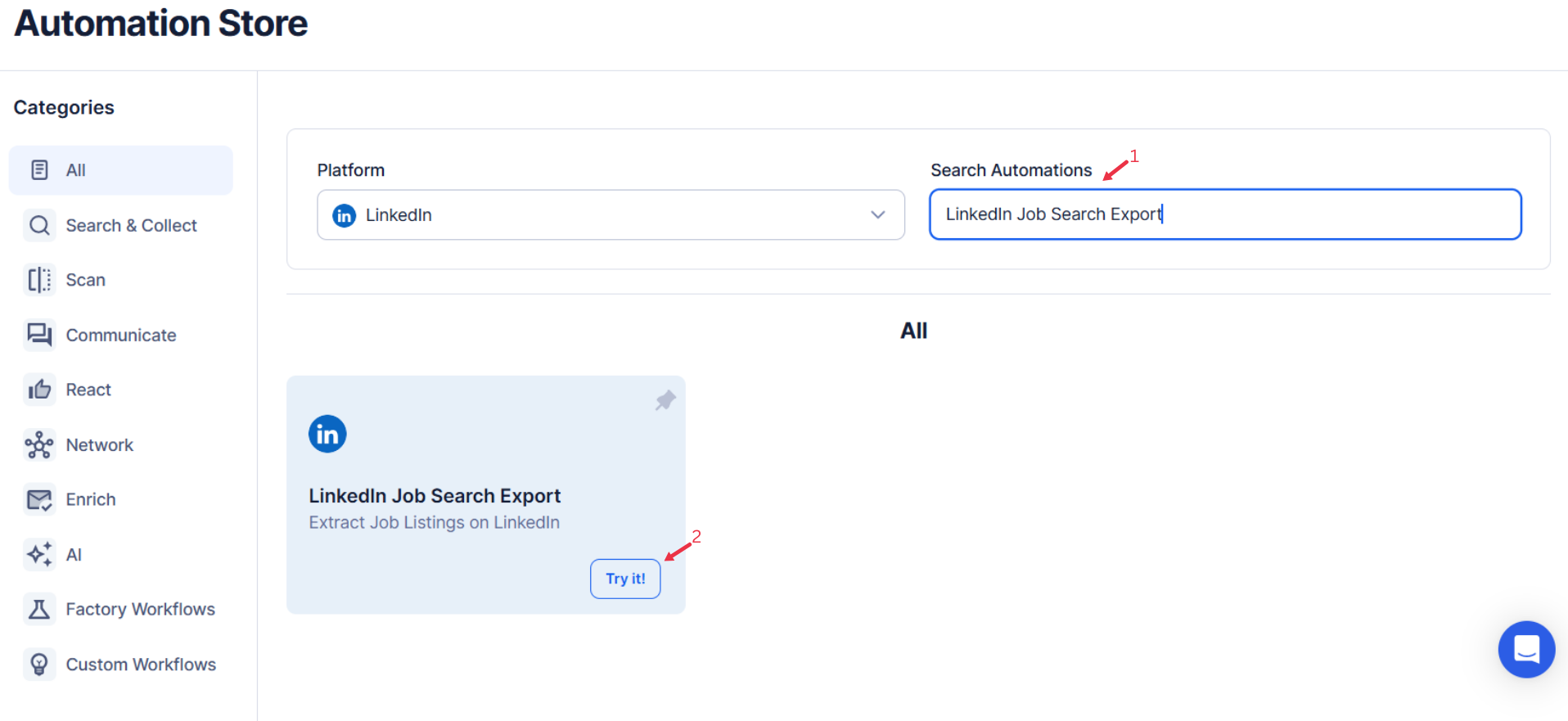
- Navigate to the Automation Store on TexAu.
- Use the search bar to find LinkedIn Job Search Export automation.
Step 4: Set Up Your Job Search Criteria
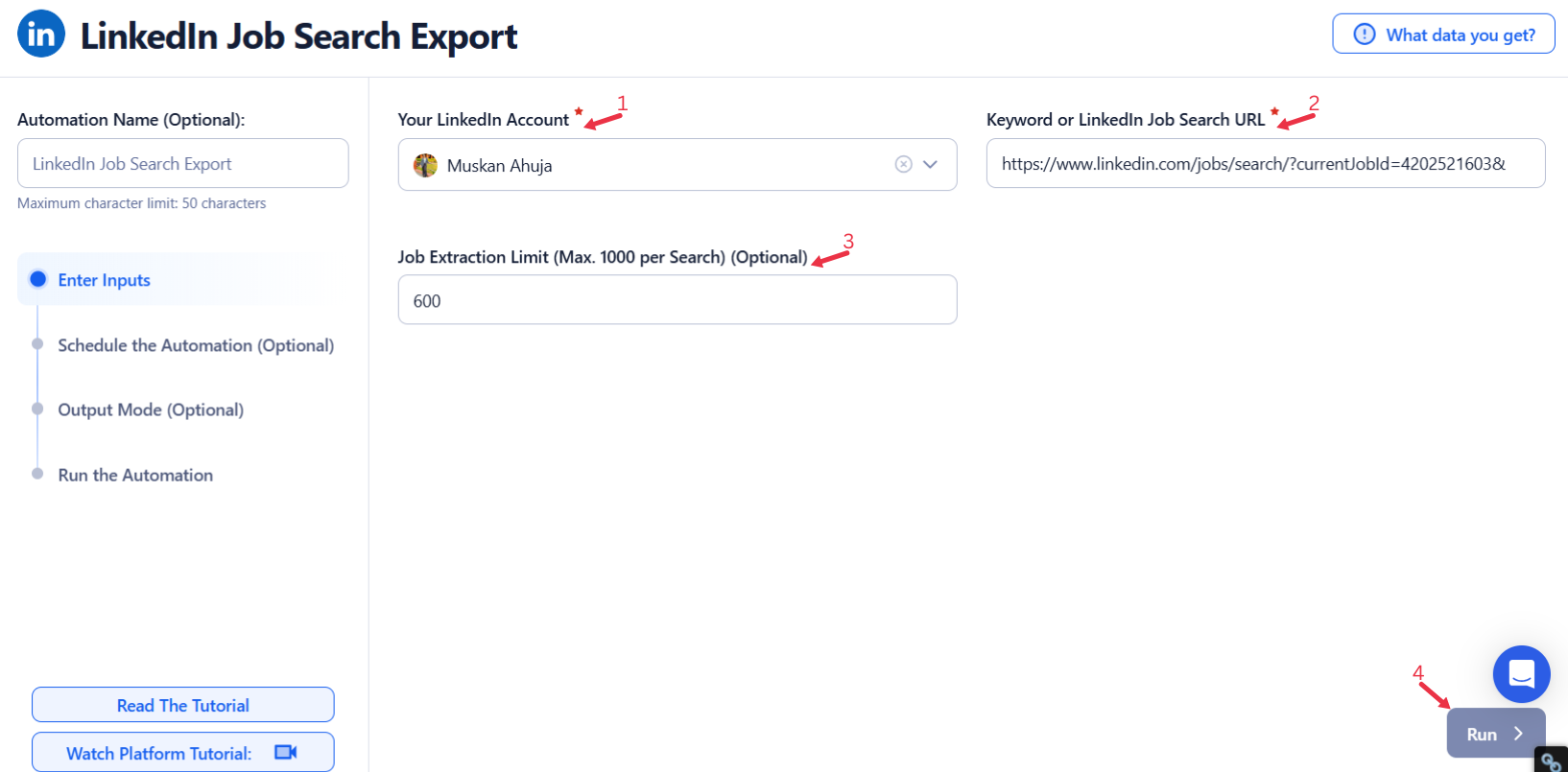
TexAu provides multiple options to specify LinkedIn job searches for the LinkedIn Job Search Export Automation, catering to the needs of recruiters, job seekers, marketers, and growth hackers. Follow the steps below to choose the input source that best suits your requirements.
Manually Enter a Single Input
Use this option to extract job details from a specific LinkedIn Job Search. Follow these steps:
- LinkedIn Job Search URL: Enter the LinkedIn Job Search URL directly into the input field (e.g.,
https://www.linkedin.com/jobs/search/?currentJobId=12345). This is mandatory to process a single job search. - Keyword (Optional): Add relevant job-related keywords to refine the search.
- Extract Limit (Optional): Set the maximum number of job posts to extract (up to 1,000 per search).
Once you’ve entered the details, click Run in the lower-right corner to start the automation.
Use Google Sheets for Bulk Input
This option is ideal for exporting job data from multiple LinkedIn searches efficiently. Follow these steps:
- Click Select Google Account to choose your account. If not connected, click Add New Google Sheet Account to link another account.
- Click Open Google Drive to locate the Google Sheet containing LinkedIn Job Search URLs.
- Select the spreadsheet and the specific sheet where the URLs are stored.
Adjust Processing Options:
- Number of Rows to Process (Optional): Define how many rows you want to process from the sheet.
- Number of Rows to Skip (Optional): Specify rows to skip at the beginning of the sheet.
Provide Input Details:
- LinkedIn Job Search URL: Specify the column containing LinkedIn Job Search URLs.
- Keyword (Optional): Add relevant job-related keywords to refine the search.
- Extract Limit (Optional): Set the maximum number of job posts to extract (up to 1,000 per search).
Click Run in the lower-right corner to initiate the process.
Optional Advanced Feature:
-
Loop Mode: Enable Loop Mode to re-process the Google Sheet from the beginning once all rows are completed. This is useful for tasks that require recurring updates.
-
Watch Row (Optional)
Watch Row feature automates workflow execution by detecting new Google Sheet entries and triggering workflows without manual intervention.
Configure Watch Row by selecting a frequency and setting an execution period.
Watch Row Schedule
- None
- Scheduling Intervals (e.g., every 15 minutes, every hour)
- One-Time Execution
- Daily Execution
- Weekly Recurrence (e.g., every Tuesday and Friday)
- Monthly Specific Dates (e.g., 1st and 15th)
- Custom Fixed Dates (e.g., September 10)
The default setting is 15 minutes, and it runs for five days unless modified.
With Watch Row, TexAu ensures workflows execute as soon as new data is detected.

Process a CSV File
This option allows you to extract job data from a static CSV file. Follow these steps:
- Click Upload CSV File and select the file containing LinkedIn Job Search URLs from your computer.
- TexAu will display the file name and preview its content for verification.
Adjust Processing Settings:
- Number of Rows to Process (Optional): Define how many rows you want to process from the file.
- Number of Rows to Skip (Optional): Specify rows to skip if needed.
Provide Input Details:
- LinkedIn Job Search URL: Ensure the correct column contains LinkedIn Job Search URLs.
- Keyword (Optional): Add relevant job-related keywords to refine the search.
- Extract Limit (Optional): Set the maximum number of job posts to extract (up to 1,000 per search).
Click Run in the lower-right corner to start the process.
Tip: Use Google Sheets for dynamic or frequently updated job lists, and CSV files for static data that doesn’t change often.

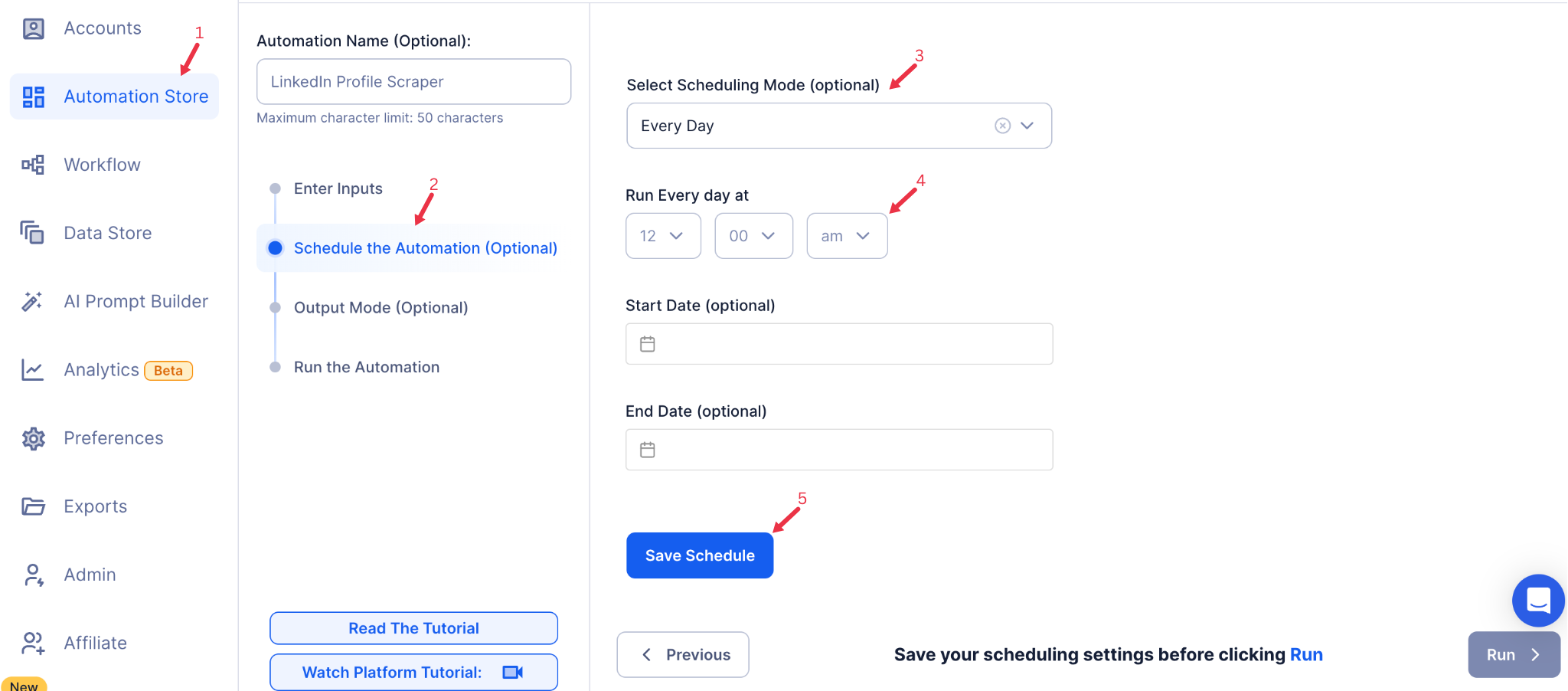
Step 5: Schedule the Automation (Optional)
To monitor job listings at regular intervals, use TexAu’s scheduling feature. Click Schedule to set the start date and time, or configure a Recurrence Frequency to update the search periodically:
- At Regular Intervals (e.g., every day or every week)
- Once
- Every Day
- On Specific Days of the Week (e.g., every Monday and Friday)
- On Specific Days of the Month (e.g., the 1st and 15th)
- On Specific Dates (e.g., March 1)
Scheduling is ideal if you want to continuously track new job postings.
Step 6: Set an Iteration Delay (Optional)
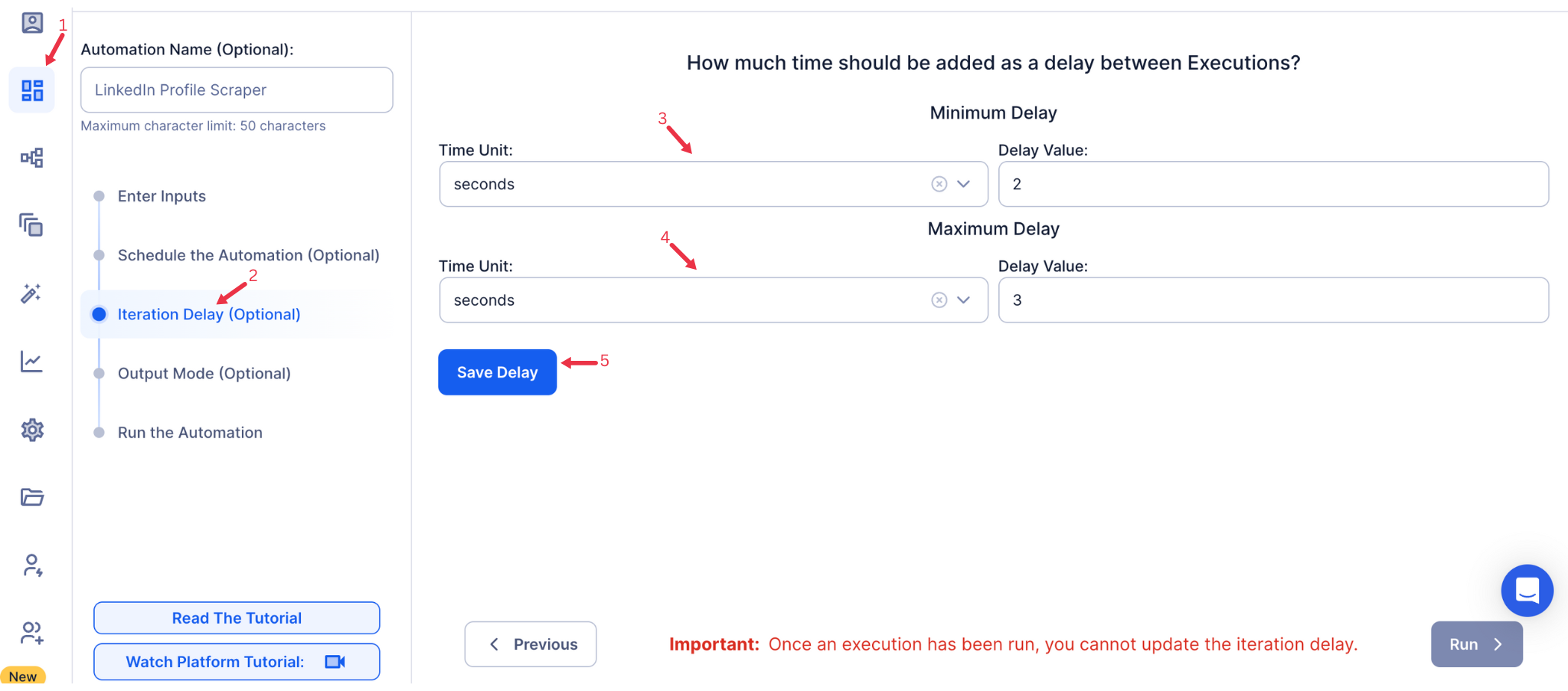
Avoid detection and simulate human-like activity by setting an iteration delay. Choose minimum and maximum time intervals to add randomness between actions. This makes your activity look natural and reduces the chance of being flagged.
- Minimum Delay: Enter the shortest interval (e.g., 10 seconds).
- Maximum Delay: Enter the longest interval (e.g., 20 seconds).
Tip: Random delays keep your automation safe and reliable.
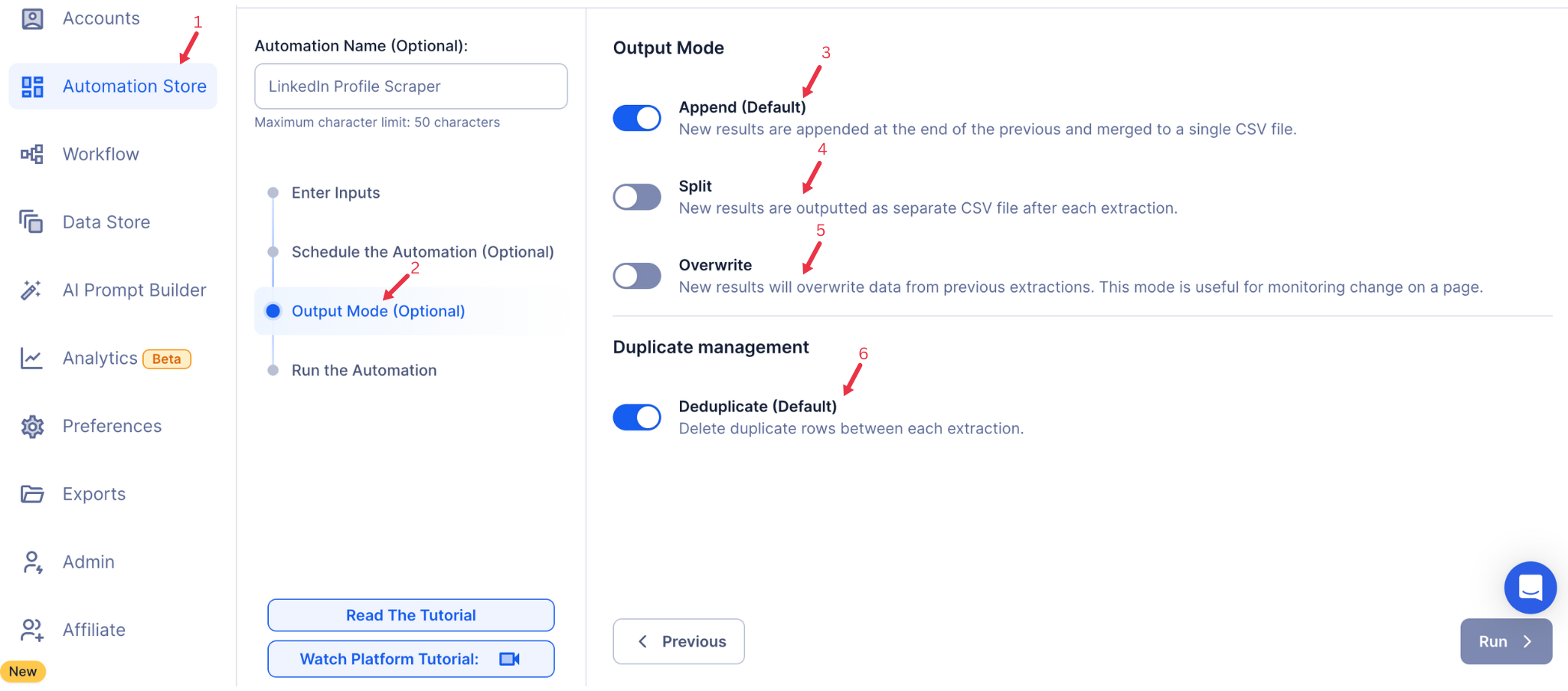
Step 7: Choose Your Output Mode (Optional)
Choose how to save and manage the extracted alumni data. TexAu provides the following options:
- Append (Default): Adds new results to the end of existing data, merging them into a single CSV file.
- Split: Saves new results as separate CSV files for each automation run.
- Overwrite: Replaces previous data with the latest results.
- Duplicate Management: Enable Deduplicate (Default) to remove duplicate rows.
Tip: Google Sheets export makes it easy to collaborate with your team in real time, particularly useful for alumni network management and analysis.
Step 8: Access the Data from the Data Store
After the automation completes, go to the Data Store section in TexAu to access your results. Find the LinkedIn Alumni Search Export automation or the name you’ve entered, click See Data, then choose either Download CSV to export the data or Open to Google Sheet for quick access.

The LinkedIn Job Search Export automation simplifies tracking job listings based on specific criteria, making it a valuable tool for job seekers, recruiters, and market researchers. With scheduling, flexible input options, and export to Google Sheets or CSV, this tool provides organized access to job data for ongoing analysis and opportunity tracking.
Run this automation on your own machine.
TexAu V2 Desktop runs every automation locally — your real session, your real IP, unlimited hours, no proxies. One-time $1,999, no subscription, 5 years of updates.